


The Truth About AI, Coaching, and What Still Makes Humans Irreplaceable
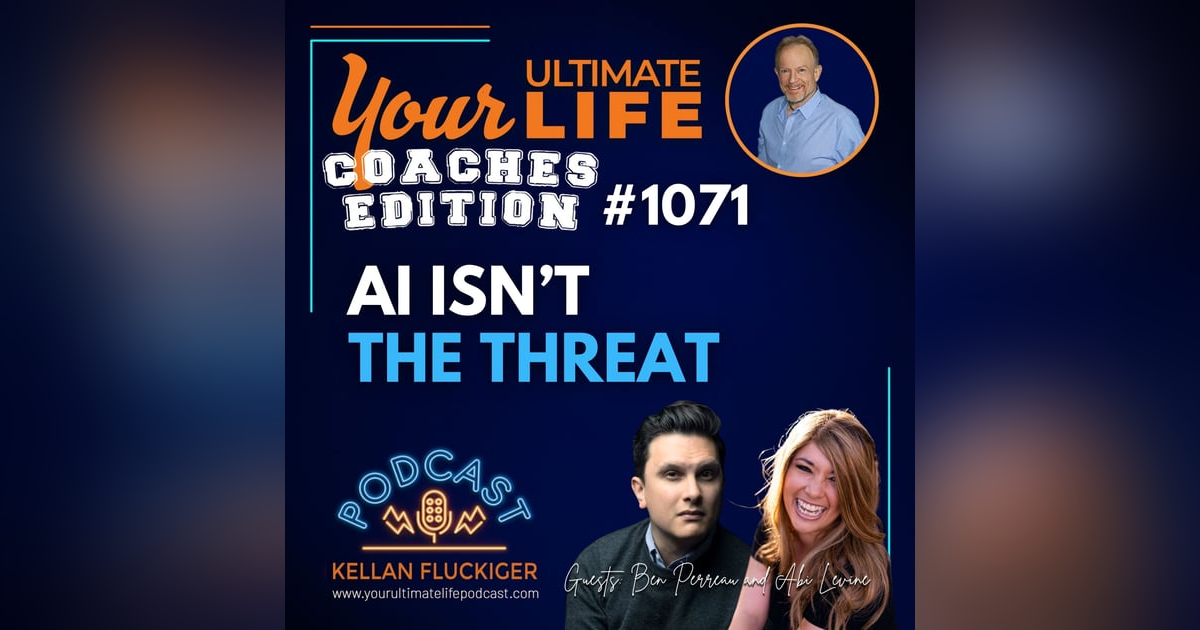


AI is transforming coaching, leadership, and business faster than most people are prepared for. But while AI can analyze, measure, and accelerate growth, it cannot replace lived experience, embodiment, or the human capacity to lead with integrity.
In this Thursday edition of Your Ultimate Life, Kellan Fluckiger is joined by Ben Perreau, founder of Parafoil, and Abi Levine, coach and creator of an AI twin, for a deeply honest conversation about what AI can do, what it can’t do, and why most coaches are about to face a reckoning.
This episode explores the future of coaching, the danger of shame-based systems, the limits of chatbots, and why the coaches and leaders who survive the AI era will be those who embody what they teach.
Key Takeaways:
- How AI is changing coaching and leadership
- Why most coaches will not survive the AI shift
- Leadership intelligence vs. human coaching
- AI as a mirror, not a creator
- Shame-based coaching and its harm
- The limits of chatbots and surface-level interaction
- Embodiment, lived experience, and authenticity
- Why outcomes matter more than methods
- AI as an amplifier, not a replacement
- The future role of coaches in an AI-driven world
🔥 Ready to turn your truth into impact?
Join the Dream • Build • Write It Webinar — where bold creators transform ideas into movements.
👉 Reserve your free seat now at dreambuildwriteit.com
🔥 Discover how to leverage your unique lived experience and embodied leadership to stay irreplaceable in the age of AI by exploring the resources from Abi Levine at [Insert Link Here] and Ben Perreau at [Insert Link Here]
Mentioned in this episode:
Visit www.dreambuildwriteit.com
Visit www.dreambuildwriteit.com
00:00 - Untitled
00:15 - Untitled
00:25 - Creating Your Ultimate Life
00:57 - The Impact of AI on Coaching
17:56 - The Role of Lived Experience in Coaching
27:12 - The Imperfections of AI and Human Experience
31:08 - The Challenges Facing Coaches in the AI Era
45:43 - The Future of Work and AI
Welcome to the show. Tired of the hype about living a dream? It's time for truth.This is the place for tools, power and real talk so you can create the life you dream and deserve your ultimate life. Subscribe, share, create. You have infinite power.Welcome to this episode of your ultimate life, the of power podcast I created to help you live a life of purpose, prosperity and joy by serving, blessing, lifting people with your skills, your gifts, and your life experience. This is one of the special Thursday editions where we talk about what AI is or isn't doing to coaching.After I wrote the book Coaching in the Rise of AI, I had this feeling that I needed to get some conversation going with people that are using it, that aren't using it, how much, why, how, that kind of thing. And so, as you know, on the Thursdays, we've been having these special episodes for a few months, and I'm going to keep this going for maybe a year.We'll see as. As time goes by. So today I want to welcome to the show Ben. That's a joke. For those of you that weren't in the green room.Ben and Abby, welcome to the show.
Abi LevineHi. So great to be here.
Kellan FluckigerAll right, cool. You are absolutely welcome. So the.The first thing since we're talking about coaching and AI and I realize AI is going to change the universe in a million ways, and we're only talking about kind of one more narrow way as opposed to the general impact on humanity. The first question I kind of want to start with is, are you using AI in your business or in your work? And if you are, how and how come?Who wants to start? I don't care.
Ben PerreauI'll start. So are we. Are we using AI? Yeah, I'm building AI.The product I'm building is called powerfoil, and I've used AI a lot to get there, and we use AI a lot to build it as well. So there's a number of AI tools we use in building software. There's a number of AI tools I use in my own productivity day to day.And I guess what we're building is a leadership intelligence tool.So it analyzes how you lead in your work inside the work, and then gives you actionable advice for how you can improve and charts your progress day by day so you can measure your progress as you go. So it's like almost like a telemetry tool for your leadership. It's an AI tool.
Kellan FluckigerCool. So let me ask you a couple of questions about that.
Ben PerreauYeah.
Kellan FluckigerSo it's called Power Foil Parafoil, P.
Ben PerreauA R, A, like the space shuttle land. Yeah.
Kellan FluckigerYeah. All right, so parafoil. And it is a leadership guide, measurement, assessment coach. Kind of something in the middle of all those things.
Ben PerreauYeah, I, I wouldn't call it a coach because I think coaches have their own role in leaders lives, but we call it leadership intelligence. So it's a, it's a foil. It runs alongside you and you use it to understand how you're leading and how you work.And then it gives you advice, feedback and measurement on how you're doing in the day to day.
Kellan FluckigerCool. So I'm going to, I have more questions, but I want to just start with Abby's involvement with this. So Abby, what are you doing with AI in your work?
Abi LevineYeah, so I absolutely use AI on a daily basis. I love it.I, I have an AI twin called Kazam that my clients can use when they are not with me, which is every other hour of the day except for when we are in our group sessions and they absolutely freaking love it. I also use it as a thought partner.You like, as someone who is fascinated by human behavior and AI being trained on human behavior, it's a really great analysis tool for me. It helps me to understand, like, where is the general consensus of society? It.I love the deep research tool because I can say, hey, this is what I want to talk about. Can you, can you research Reddit?What are the questions that people are asking today about this particular subject that I'm, I'm, I'm interested in talking about today? So yeah, I absolutely love it.
Kellan FluckigerCool. So let's just go back. Let me go back to each one of you and tell me what got you excited about the possibility of this tool.Because like, what is it that made you decide this is the time for the tool process that I'm using? And, and what made you excited?Because both of you have said, gee, heavily involved building it, using it, love it, create names for it, you know, pets you feed it, I don't know, whatever. But like, what made you decide to do this and get you involved in this?
Ben PerreauYeah, I'll take that first. So two things.One is just reflecting on my experiences when I first became a manager at the age of 24 and how hard it was to make that transition from being a journalist to managing people for the first time, and how bad I was at it.Oscillating wildly between massively over delegating and being laissez faire and then being incredibly directional and quite tough in the newsroom and not really having much vocabulary in between to really help people understand what good looks like and how to be able to kind of inspire people to succeed. But actually for the last 10 years before I built Powerful, I worked for a leadership and strategy firm that was started by early Apple employees.And so I got to see what leadership looks like in the C Suite for Fortune 50, Fortune 100 companies. And so in working alongside those leaders, I realized two things.One is a, they have access to masses of resources and in some cases cadres of coaches who are helping them work, as well as a lot of compensation that can help them with the tools they need.And then I also realized that organizational culture, decision making, all the really important stuff that's happening in an organization happens at the front line. Big decisions get made at the top, but a lot of what is getting carried by the company is happening on the front line with the frontline managers.But we didn't really have as many tools in a services firm to be able to go and work with all of the managers inside a company.If you're Talking about a 2,3000 person company, that's 4 to 500 people, it's pretty hard to give them a one to one experience with a one to one relationship. So software had to play a role.And the advent of AI and software has made it possible for us to be able to build more and more context about your work life.And so through that context we can start to use that to build a leadership development AI, specifically one that's not general purpose, but specifically for this reason.And so we've built that and we use that to help managers who are just stepping into the role get better at their job and get more confident, honestly. So that's kind of how we got there.
Kellan FluckigerI have a follow up question. Yeah, I have a follow up question. Go ahead. You have a comment on that, Abby?
Abi LevineYeah, I love it. First of all, I love this conversation. It's so dynamic because I'm coming from within the just purely human psychology perspective.So I love hearing about its application in real world business from a psychology perspective. It's so interesting to me. I love what you created. It's really brilliant.
Kellan FluckigerWell, what it made me think of is I don't know if either of you are familiar with an Apple TV program called Severance.
Abi LevineI love that show.
Kellan FluckigerOkay.
Abi LevineOne of my favorite shows.
Kellan FluckigerSo when you talked about the business part of this, I'm thinking of the Severed.You know, for those of you on the program that don't know, this evidence is a sci fi sort of thing where you go down an elevator and go to work and everything about your personal life's cut off and you go back up at the end of the day and everything about your business life's cut off. So you're actually two different people and it's really weird.And we're not going to talk about the show here, but what I, what it brought for me, both of you, but Ben, you brought it up. The question is the integration, like for a long time I worked for a CEO. I was the COO in, in the corporate years, which was some years ago.But that was, you know, this is it. Leave everything at home. I don't care if you get divorced.You owe your life breath and everything else kind of, I owe my soul to the company soar kind of thought. And today we don't. We know that's not helpful. It's not true. It wrecks people's lives, hearts and it certainly impacts productivity.So when you think about leadership, this application of how they're functioning as leader, how they're doing, what element and Abby's pushed on this area, what elements of the integration are brought into that. When you help somebody that way.
Ben PerreauYou know, we measure your leadership output. But of course, to your point, Kellen, understanding the inputs, understanding the context of somebody is important.And so I think where Powerful starts and ends is, it's most interested in how you show up, what are the outputs that you are delivering into your work. And so that means the way that Powerful works right now is it's an app that runs in your meetings and in your conversations with your team.And you can switch it on manually or you can set it up to run with your calendar and it will analyze those conversations for you and then give you a kind of like a post match report after each one of your interactions with your team and give you an understanding of what you did well, what you might be able to do better based on the goals that you set. So it makes it possible for you to kind of start to work towards some of the things that are important to you.Now, what a coach will do fantastically that Power four won't is it will pull back and start to look at your life and the exposition. And those are the things we would do in our work one to one, many years ago.Powerful is much more about the output and the measurement of what's going on in your work.And what's great about it is it creates really low latency moments for you to be able to just go in and go, hey, here's what happened in that interaction. Just A second ago. How do you feel about that? Rather than necessarily waiting for the time.
Kellan FluckigerWhen you get an hour a day, a week later. Right, right, right. Abby, I want to come to you about what brought you into this?Same question I started with, with him on what, Tell me what brought you into this.
Ben PerreauAnd.
Abi LevineYeah, absolutely, yeah. So I have this friend who is, who is toying with a, creating his, his own AI agent.And he was so hyp about some of the results that some of his friends were getting from interacting with his AI agent. And he started saying things like, very similar to what you said. AI agents are going to replace coaches. Check out my agent.And so I was deeply curious and so he let me try it out. And within 48 hours, I learned more about myself than I had with my coach in the previous, I want to say like six months. I had massive breakthroughs.I, I developed my, my next like one year marketing plan within 30 minutes that I've been struggling with for like, I want to say years. Like, what I was able to create in a matter of two days was so incredible that, that I, like, it was a paradigm shift.I had an entire paradigm shift within those 48 hours. And, but, but his software irked me, his agent irked me because it was so shame based.Like everything that it would come back with, it would come back with a shaming tone. And I was like, this is bullshit because the information is great, but the delivery is awful.And then it started to get me reflecting on the coaching industry and I realized that a lot of coaches are shame based. And I realized that this is actually how a lot of coaches speak.And so then I was like, okay, I want one of these, but I want it with my own coaching style, which is very acknowledging, which is very accepting of meeting people where they're at. You know, it was missing the trick with a lot of belief systems with belief processes.It was very like Blamey with the way that it was like you were doing this and I was like, wait, just a cotton pick. And second here I already know that it's my responsibility to correct that.But don't you dare for one second make me think that I'm the one who created that, because of course I'm not. I inherited it from society, from childhood.And then the secondary aspect of wanting to create my own coaching agent was because, I mean, my minimum baseline package for someone who wants to work with me one on one. And I don't take one on one clients very often because I'm very much mission driven right now.But but my starting rate is 100k, so, and, and I love people. I love people. And so when people. And I'm very engaged with my community and I know that 95 of my community can't afford 100k.And not only that, I just don't open one on one containers very often.So I really wanted to provide them with something that would give them access to, you know, the information that I have, the, the wisdom that I've created, created, downloaded my synthesis of the information that exists and, and just let them have access to that without the 100k price point. So that's, that's how I came to it.
Kellan FluckigerSo you raised a couple of really interesting things. And that is one of the premises about when I say 95% of coaches won't be able to make a living by Christmas.It is with coaching as it is today, with coaching as it has been sold. The, the systems, the tools, the frameworks, the questions, the, the boxes that have been built and what passes for coaching.And the, the, the, you know, you've touched on it. The idea is, okay, if that won't work anymore, we have to have a new model, we have to have a new approach.And I'm not saying that some people aren't already doing that, but that has cause that's the only approach that's going to survive.Because AI writes faster, it writes better, it does better research, and if you train it a little better, it doesn't spank you, spank you and piss you off when it's trying to give you advice. So that was the thing. I did research and then I said, well, then we need to do this. And that's what I wrote about in the book.
Abi LevineYes.
Kellan FluckigerBut what I want you both to add, think about right now is what are the pitfalls like if you think about AI and its application to do? And both of you have given some really positive possibilities and already things you're doing, you know, I'm building a coach by Kellen Bot.It'll be ready in about a month. And I have 23 books and thousands of videos and podcasts and coaching sessions. And so, you know, I ask, I got a developer and et cetera, et cetera.And it was a funny thing. I was talking to Chatty and I opened a thread called One Million Words.And so I started putting all kinds of stuff in it to train it, how I talk and what I'm thinking about, everything else. And after a while it came back and said, try 4 million. Okay, wrong name. Anyway, it was kind of Funny.All right, so I want you to talk for a minute about what are the possible pitfalls or problems. And I'm not talking about Skynet or Terminator, but I mean, in the context of that, we're talking about what are the problems.
Abi LevineOh, I'm very opinionated about this. So I'm gonna, I'm gonna hop in first then, if you don't mind, please.So one of the things, and this is one of the reasons why, like, when I see things, by the way, I agree with you 100, Kellen. Like, there are 95% of coaches that will go out of business because they were the hacks in the first place.They don't actually know what they're teaching. They're teaching based on a book that was written in the 1950s. And this is not meant to disparage them.This is that they've been coasting on regurgitated material or their marketers, or they're simply marketers that are selling the business and like a system that has no soul, like you put it. But one of the things that AI simply will never be able to replace is lived experience. You call it. It doesn't bleed right.Human beings are biologically programmed to receive electromagnetic transmitted information from other human beings. That's just the beauty of our, our nature, of our makeup of our body. And so within a space split second, we are receiving so much information.I mean, we're processing 11 million bits of information per second. And so much of that is coming from the people around us.And because of the, the divine intelligence of ourselves, we are also making assumptions and, and generating beliefs about the things that we're interacting with. And we have the capacity to decrypt and decode and digest and inte split seconds that which we are receiving from others.We call it authenticity, but it actually has a scientific basis. And our lived experience travels in that code.Okay, so some of the examples that I like to use on, on a regular basis is the person, the 22 year old personal trainer who has been fit, thin and gorgeous their entire life, trying to teach the post menopaus mother of six who has been overweight her whole life, how to lose weight. There is a lack of lived experience. There is a missed connection. And that mother can feel it so deeply, so implicitly. She can feel, you don't get me.Like, it's not as simple as don't eat the chocolate. It's not as simple as stop eating at 8 o'. Clock, right?Because there's a, there's, there's decades of lived experience that are built into those neurotransmitted electromagnetic messages that people get. It's the same as being tried to be coached by someone who's like abuse coaching. Right. That's that. By someone who's never actually experienced abuse.You can feel it. You know it. You can, you can in. You can get it from the words that they use or don't use. It's, it's. It's a lived experience that is missing.It's the orchestra, as you so eloquently put it. It's the orchestra without the sou. It doesn't bleed. Right, so that's one and then one of the other ones.I got a whole list, but I'm going to keep it short so Ben can have a word in here as well.
Kellan FluckigerGreat.
Ben PerreauKeep going.
Abi LevineYeah. Then the other one is. It's simply a mirror. It is simply a mirror. It is only a mirror of all the data that has been before. It cannot dream.It cannot predict. It is also quite often after interacting with a person for just a short period of time, becomes a mirror of their own psychology.So, yeah, it can be incredibly validating. It can coddle you if you. If that's how you like to be spoken to, it can. It can be sharp with you, if that's how you like to be spoken to.But it is only a mirror of your psychology without the intuition which is now. And talk about intuition, because it's now been scientifically proven to exist. You know, it's, it's, it's. It is simply that which has come before.And that doesn't mean it can't create it. It can do what looks like creation because it pieces information together and very unique.And perhaps the person who is reading it has never perceived that before. It's not necessarily creation, and so it'll always be limited by the only thing. It's essentially the same way that logic works.The only reason that logic works is based on the data that has come before it. And so it's not predictive. It can't intuit, it can't. It can't dream.It can paint visions, but it can't actually dream up possibilities, in my personal opinion.
Kellan FluckigerThat's what we're asking for. All right, good. So obviously you have no passion or real feeling around this.So, Ben, I want to open the mic to you and I want you to whatever, you don't have to agree or disagree, however passionate she is about it. What do you see as the potential pitfalls?
Ben PerreauI also love. I love the. I. I Love how passionate and informed you are, Abby. It's really so interesting, like, clearly to hear about your perspective on it.And I, you know, I couldn't agree more, actually, almost everything you've said. You know, I think when we talk about AI, for the most part, we're talking about chatbots, right? And powerful is not a chatbot.It's an AI model that sits in the background and deploys a whole lot of information to you. But there are a lot of pitfalls, in my opinion, when it comes to how we think about AI in the context of chatbots.Chatbots are in design, we call them a skeuomorph. They're trying to synthesize something that exists in real life. And it's a very thin surface area with which to interact with anything.Text, chat, back and forth. The surface area there is not as rich as this conversation we're having right now. It's not as rich as, quite frankly, clicking around on a website.It's very, very, very thin and narrow. And so the richness of the way that you can interact with that is all funnel. It's like drinking your meal through a straw.All of your content is being deployed in that way. And so I think one of the things we have to be careful of with that is our window and our aperture into what's really going on is incredibly narrow.And so maintaining discernment and understanding. And I think this kind of speaks to Abby, you were talking about, and understanding what is actually happening there.Most of the LLMs that are driving chatbots are prediction engines that are guessing what the next word should be on the basis of the words that have gone before, to your point, just on that basis. It's also incentivized to drive better engagement with you.Therefore, the goal is to get you to commit more words to it so it will commit more words to you, and so on and so on. And that's how the machine works, which is, you know, just like Instagram, where you put more photos in and it gives you more stuff back.You put more browsing time and it gives you more stuff back. It's not completely different to that, in that. In that most of the people who work at the large AI houses are incentivized around engagement.And so you have to be wary of, I think, what it's coming back with often, because sometimes it can be hallucination. We've. I'm sure we've all talked about that plenty of times. Sometimes it can be sycophancy.We've talked about that a Lot of times we're trying to eradicate both of those things, but they're not. They're not gone yet. And sometimes it can just be unhelpful that the tone, Abby, you talked about this.The tone, the style, the way it comes to you can be unhelpful. And so I think there are plenty of pitfalls when it comes to how we think about what we interact with what we've come to call AI, for the most part.And I think we should be wary.And what we found in the Web2 era was our understanding of what's going on fell quite a long way behind what the engineers at the large tech companies were actually able to do. And we need to make sure that doesn't happen again.And we need to understand that what they're capable of doing, not necessarily even in a nefarious way, there is a pretty gigantic delta between our understanding of how, let's say, a field like data science works, which is contributing towards how AI is built, and what's actually coming out the other end of the engine. So I think it's sort of on us as consumers of AI to really recognize where it may head off into a funny direction.And we may not necessarily be aware that it's taking us into a funny dog leg of a conversation where a human would have the empathy, the lived experience, the care, the incentive structure, quite frankly, to make sure that doesn't happen. And so I think we have to be mindful of that when we're engaging with chatbots in particular.
Kellan FluckigerAbsolutely.
Abi LevineVery well spoken. Sorry, can I pop one more thought in there before we. Please do move on? Yeah, that was.I love the way you put that with the surface area, because that's so tangible. And like your, Your. Your example of drinking a meal through a straw, that's absolutely. That's. That's the experience of it.And if you try to apply that and think that your. Your meal through a straw is now representative of society or your life in general, you're gonna get way off track. Yeah, absolutely.And the other thing, one other thing I wanted to speak to was a little bit more into what you call the orchestra without the soul, Helen, which is that. That there's something about the imperfections that, that land in our bodies as I am. Okay, right.Like when we're engaging, it's one of the reasons why I lead with my imperfections, I lead with my mistakes. Because I think that one of the. The crazy tangents that coaching took was creating a bunch of superheroes that, that essentially make no Mistakes.This is my perfect life.If you want to achieve my perfect life, all you have to do is pay me $10,000 an hour power, you know, and, and it created such grandiose misnomers, like completely absolute misunderstandings of what life actually is. And it reinforced this idea that perfection is possible. And so I lead with my imperfections because that reminds people it's okay to lose a thought.It's okay to have a brain fart when you're on a podcast. It's okay to be sick and recovering and still show up. It's okay to call someone by the wrong name like it's okay three times, like it's okay.
Ben PerreauCan I forgive you?
Kellan FluckigerI received that.
Abi LevineIt'S okay to be human. And, and one of the biggest hang ups that I think that humans actually have is our lack of acceptance of, of our humanity.And so if we're going to try to now delegate coaching to a machine that is incapable mostly for the most part, of imperfection, we are only going to expand and increase the psychosis that is already running rampant in the human race. So authenticity and that, that, that just lack of perfection. Just your imperfections. Kelly said it beautifully.The breaths, the stumbles, the jitters, when you miss the mark just by a little bit or you get lost in thought or, you know, those are the things that, that settle the nervous system when someone is doing this deep work, which requires an immense amount of trust, an immense amount of vulnerability, an immense amount of humility and willingness to confront the stuff that you have been literally running at top speed away from for your entire life. And, and, and it feels most safe to do that with a human who you feel guessing in my, in my opinion.
Kellan FluckigerSo there's three. There's three things because you've laid the groundwork for this. When I say 95% of coaches will be out of business unless.And then there's a big unless that I talk about in the book. And there's three things that I think are barriers to coaches moving to what they're going to need to be.Because I think the coaches who remain and the words that I use are the embodiment, the only ones that are going to be able to transmit the truth that you've described, Abby, and that, Ben, you've talked about is those who are the embodiment of what they teach. And it isn't what comes out of their mouth, it's the energy from their being.In other words, they walk into a room and they are what they say they are, and it's Obvious. And I don't mean strutting and being cool. I'm just talking about integrity, truth and all that stuff.So I think there's three things in the coaching industry right now that are going to prevent or hinder coaches from getting to the elevated place. Because the 5% that are left are going to be well paid, really needed and very successful and have a huge impact. Okay? And here's the three things.One I. The first one is what I call the head in the sand problem. And that's the ones that are going to pretend that this isn't happening.You know, the ones that I see this in Facebook posts. Well, I'm already. AI is not going to do anything. You know, it's the human touch and I've already got that. Okay, good.If that's how you're thinking right now, you're dead. You're finished.Get off the stage because you haven't even thought deeply enough about it to know what you're talking about it, to release it or to dismiss it that glibly. The second problem is what I call the anti problem. Okay. And I describe it this way.Picture a big casino and there's all these blackjack tables and you go in and you're looking for a place to sit down and you see all that, the, all the ten dollar tables, the whole casino, they're all, all the chairs are full and they're full of robots. And the only place there is for you to sit down is in the high roller room where the anti's 10,000 bucks.And what I'm saying with that well or poorly is that the ante to be effective in this profession has gone way the frick up. And if you're, you know, and, and that's just absolutely.And the third thing that's going to keep people from doing going there is what I the mountain it being consistent left.Like if they're looking at their leadership and they don't turn on their thing and they don't really take advantage of it and they don't lean into the truth of the analysis of even momentary. Yeah, you know, I could go make that clean that little mess up right now based on this analysis.But I really don't want to because it's a little scary and I don't really want to fix that right now. And I'll wait till an hour or tomorrow or maybe never or whatever until it fades into yesterday's news. The journey up the mountain of embodiment.Whether it's great leadership and empathetic empowerment of those that work for you or any other aspect of that same activity in other areas of life that requires that the coach or the leader or the person who's in entrusted with that sacred space be constantly on the journey about who they're being. It's not a jacket you put on. And so those are the three things that I think are going to get in the way.And only those people that sort of, not sort of, that full on embrace that are going to be in the 5% who have super value but who have a meaning in the, in the world to come. So that's the thesis and I'm interested in what you guys think.
Abi LevineYeah, I'm gonna hop in real quick then, if you don't mind a minute. I'm very assertive. I've lived in America for quite some time now, so it's, it's deleted so much of my British politeness.So, yeah, you're already seeing this. You're already seeing this, right?You're seeing the skepticism that people have because we are now post Covid, we went through this, this insane era where anybody could start an online program and make 100k with a launch, right? Didn't matter what kind of expertise they had, it didn't matter what kind of training they had.They had an idea, they started an online coaching program and, and boom, they've, they, they made 100k, they made 200k, they made a million dollars.Well, now we're in the post Covid era where people have been ritualistically burned by spending so many tens of thousands, hundreds of thousands of dollars on these, on this emptiness, right?This emptiness that does nothing, that creates nothing, that offers nothing, Putting the blame on the consumer in the first place, saying, well, you know, reinforcing their original trauma, which is that they may be irrevocably damaged and there's nothing that will actually work. So reinforcing that divide, which don't even get me started on that one because man, I got some, I got some righteous anger behind that one.But then, but then also has, has, has really burned their fingertips to the coaching industry as a whole, you know, and so there's that skepticism now there's, there's a longer window that people just need to sit and shop and make sure that you are who you say you are.And you're already starting to see those coaches who are still hiding behind their lack of willingness to climb the mountain, their lack of willingness to do the work and hiding behind this in their Instagram veneer, right? They're well curated set of posts that makes their life look amazing, whether they rented that house for the day, for the photo shoot or whatever.Like you're seeing them falter, you're not seeing their ads anymore, you're not seeing them in programs anymore. You're not seeing them anymore. So, so I, I absolutely agree with that because essentially, AI is an amplification tool.And amplification does one thing. Same as money, same as power, same as influence. Amplification simply amplifies what is there in the first place.And if what is there in the first place is nothing, it's going to amplify that. If what is there is lived experience and soul.And you know, this, the work, climbing the mountain, doing the thing, being willing to do the hard stuff so that you can show others how to and that's what AI will amplify.
Kellan FluckigerBen, thoughts about those three things or anything else that comes to mind in that context.
Ben PerreauI know, I, I, I, I, I couldn't disagree. I agree, I agree with, with, with your observations, Kellen, and, and yours, Abby. You know, coaching is a, is a method, not an out.My opinion is the folks who will survive the AI era will be folks who are most focused on the outcome. What am I trying to achieve with my clients? What matters in terms of when I get them from A to B? What is the net result of spending time with me?And what does that get them that it couldn't otherwise and, you know, powerful? We've devised a method that is non competitive with coaching. In fact, I think it's a wonderful compliment.But when you're coaching, you know, if you're, I think, overly focused on just the method of going in there and having the conversation, of course that matters to be focused. But you know, I think what matters most is that we all continue to focus on the outcomes.And actually that may mean that we are willing to think unconventionally about the methods that we're going to deploy in order to achieve the outcomes that we want to. And all of us, the three of us are here because we all believe that, in the importance of those outcomes and how critical it is.And I'm sure that's the same for a lot of your audience. Kellen. We all believe in those outcomes and how important they are.In many ways, we're all here to try and achieve those outcomes by whichever means we need to.I hope that coaches will continue to think about that as they're thinking about how to evolve for themselves in their own individual, authentic way for the next era.
Kellan FluckigerBen, what I'd like to ask you now is about your particular product you mentioned. It's a compliment.It's focused mostly on this leadership part which is fabulous and is very needed as the world changes its relationship to work to what matters, as AI does, what it's going to do with other areas of the workforce and everything else. Yeah, tell us where to find stuff about this, about the tool that you have about maybe book, I don't know if you've written a book or two or ten.Where is that? So that we can explore the audience can explore the applications to leadership, whether it's in corporations or their own life.I mean I can see, you know, self leadership having an application to that too. And it may or may not be designed for that, but whatever. So tell us more about that.
Ben PerreauYeah, I think Powerful is a great tool to run with coaching, so I would encourage coaches to use it in concert, to use your orchestra analogy with their clients. And the reason for that is it can ride alongside at the times when you can't be there.Then you can pull all of the reports and all of the data out of it and say, hey listen, let's talk about this because we need to go through the exposition because it's good processing for you as a client, but also as well as the processing, let's also go and look back after we've had a chance to talk about it and look at the record and say let's see how it went. And you get more objective. Now AI is not bias less, but you get a less biased, more objective view on what's going on.And so Parafoil CO is the URL P A R A F O I L co and you can email the entire team, the whole organization, humanspowerful co. So you can email the AI Powerful co. That's not something you need to do. And you can email all the humans humansowarefall co. And we will reply.We read every email. And so if you want to get hold of us, please, I'm super curious to talk to you.I think coaches and Powerful will work together more or at least coaches and AI are going to work together more. It sounds like both of you are working on that in a way that's going to be super useful to all of your clients and many more. So. And that's us.
Abi LevineI have another and just one additional thought to add.I totally agree with everything that you said Ben, about how that works alongside it and Nava and another aspect that you maybe aren't super aware of is coaches are terrible at running businesses like Awful. They are so bad at running businesses in general because that's not their level of genius.Their level of genius is being in session with their clients, creating the transformation. So when it comes to growing teams, powerful could be incredibly useful, right?When it comes to, you know, growing teams, scaling their businesses, running certification programs, you know, developing their leadership, developing company culture that is so prevalent in, in corporate. But coaches are, you know, often unicycle entrepreneurs that are trying to do it all.And so that's what that, I mean, that's from my perspective, I hate managing. Like as soon as, as soon as I have the opportunity to hire a full time coo, that is absolutely what I'm going to do.Because I'm not interested in being anybody's manager. I don't want to follow up and see if you've done it. I want you to tell me you're going to do it and then just do it. Right?And so like, that's another way that powerful can really support, I mean, all, not just coaching industries, but all industries, all entrepreneurs who really need to develop their leadership skills and their management skills because it can bridge that gap that is really difficult to bridge when you're reading a book because there's that separation, right? You can read all the coaching books or the management books or the developing your corporate culture books, but there's still a separation.Like, how do I actually apply that to me? And you've solved that problem by saying, well, just watch what I do and then you can tell me, you can tell me how I apply that to me.
Ben PerreauYou know, what you say about books is so important. I mean, obviously books are a really great store of knowledge and I hope they continue to be a great store of knowledge in the future.And I believe they will be. And praxis is how I've done most of my learning. So that knowledge needs to get put into action.And you know, powerful is all about measuring that praxis and giving you moments to go and put that knowledge into motion so that you can create the small, tight learning loops that you need to, to be able to go and improve. So I couldn't agree more with that.
Kellan FluckigerYeah, well, that's fabulous. So we're about our time. This has been a very interesting conversation. Before we get done, I want to ask each one of you, what didn't we talk about?What didn't you say that is really important and it's not a master's thesis, but just, you know, an additional thought that it's like, oh, I really wanted to say X. It's got something.
Abi LevineOh, yeah. I always have something, Kevin.
Kellan FluckigerI had no doubt.
Abi LevineSo I think one of the things, and this is something that you point really well at. Ben, you just mentioned that. Kellen, I know that this is part of your mission. You mentioned it at the event, is. Is practical application.You don't want people to just know that they are divine. You want people to start acting out their divinity.And that's one of the things that I try to impress upon everybody I come into contact with, is you are not. You're not born to live a life of mediocrity. Stop it. Stop it. Like, stop coddling your comfort zone and, And. And do a thing.Even if that thing is taking a good long look at what you were born for or how you can bridge the gap between where you are now and what you came here to be.I truly believe everybody just actually came to us to be themselves and that if everybody just lived in their creative genius, the earth would be great. And then the last thing is, if you want to follow me, the best place to do it is on Facebook, my Instagram, my LinkedIn.All those channels are run by members of my team, but Facebook is me having my. My daily life thoughts and lived experiences and. And processes. So, yeah, just find me on Facebook.
Kellan FluckigerThank you. I was going to ask you that. So thank you. Do you have any final thoughts for us?
Ben PerreauJust briefly, I would say I know there's a lot of concern and anxiety around human replacement of jobs, that kind of stuff. And I think, you know, kind of many of your prophecies, I'm sure, will turn out to be true.But also, I think there's still significant opportunity for everybody who chooses to find the thing that makes them different and find the people who care about that. And if you can continue to do those two things, you will be able to find work and things to do and be gainfully employed, I'm sure.So I would take a moment, if everybody's particularly concerned about that stuff, to breathe and realize that the future might not be just full of robots and completely as bleak as you think it's going to be.
Abi LevineThank you. There's truly no scarcity. I mean, there really isn't.It's just AI is here to help us shift into exactly what you said and exactly what your book talks about. It's just here to help us shift into our power.
Kellan FluckigerI want to appreciate, I want to thank both of you for coming and sharing your heart, your love, your insight, your excitement, your creations, your passion with us. There is no doubt. There is no doubt that there is opportunity. And thank you for reminding us of that, Ben. That there's no doubt.There's no question you have something to do. You were born to do something. You have to develop your skills and talents and go find it and take some risks and go do stuff. Yes.But you have an opportunity to make a difference, to get paid, to get paid well and to do. To do something that feels meaningful. So, Abby, thanks for being here with me today.
Abi LevineThank you so much for having me.
Kellan FluckigerYeah, Ben, thank you for being here today.
Ben PerreauThank you, Kellen. It was really a pleasure.
Kellan FluckigerThanks all of you listeners. I'm going to encourage you to listen a couple of times like always.These Thursday episodes are completely different and they spark just some different ideas.And the intent is for you to be encouraged about your opportunity, to be realistic about the path from here to there, but to also encourage you every time with every episode that nothing can prevent you from living your ultimate life.
Abi LevineOpen your heart. And this time around, right here, right.
Kellan FluckigerNow, your opportunity for massive growth is right in front of you. Every episode gives you practical tips and practices that will change everything.If you want to know more, go to kellenfluekegermedia.com if you want more free tools, go here YourUltimateLife.ca Subscribe.
Ben PerreauHeart in.
Kellan FluckigerThe sky and your feet on the ground.